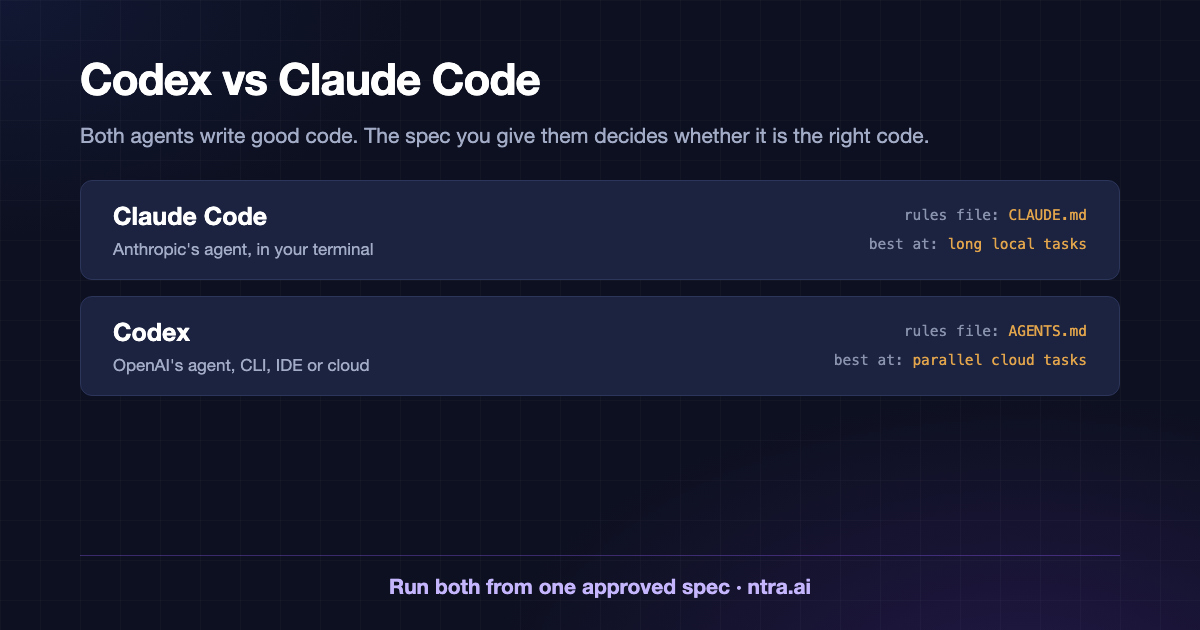
Claude Code and OpenAI Codex are the two coding agents most teams end up comparing. Both read your repo, edit files, run commands and work through a task until it is done. On a good day, both write code you would merge.
So the real question is not "which one is smarter". It is which one fits the way your team works. This post compares them in daily use, and then looks at the part that matters more than the pick.
What they have in common
Both are agents, not autocomplete. You give a task, and the agent plans, edits several files, runs the tests and tries again when something fails.
Both run in the terminal and in the IDE. Both read a project instruction file: CLAUDE.md for Claude Code, AGENTS.md for Codex. Both can connect to outside tools through MCP (Model Context Protocol, a standard way to give an agent tools).
And both have the same weak spot. Give either one a vague task, and it will fill the gaps with guesses.
Claude Code
Claude Code is Anthropic's coding agent. It runs Claude models and works mostly in your terminal, on your own machine, inside your real repo.
Where it is strong:
- Long, careful tasks. It is good at reading a lot of code before it changes anything, and at following project rules.
- Customization. Hooks run your scripts at fixed points, subagents split work, and skills package a repeatable workflow.
- Local control. By default it asks before it runs commands or edits files, and you can widen or narrow those permissions.
Where teams hit limits: it works best with a developer at the keyboard. Running many tasks at once means many sessions to watch.
OpenAI Codex
Codex is OpenAI's coding agent. It runs OpenAI models and comes as an open-source CLI, an IDE extension, and a cloud version inside ChatGPT.
Where it is strong:
- Cloud tasks. You can send a task to a cloud sandbox and come back to a finished diff, which makes it easy to start several tasks at once.
- ChatGPT plans. Teams that already pay for ChatGPT can often use Codex without a new contract.
- Open-source CLI. The CLI code is public, which some security teams like.
Where teams hit limits: cloud tasks run away from your local setup, so anything that needs your local services or secrets takes extra work.
Codex vs Claude Code at a glance
- Made by: Claude Code: Anthropic. Codex: OpenAI.
- Main place it runs: Claude Code: Your terminal, on your machine. Codex: CLI, IDE, or OpenAI's cloud.
- Project rules file: Claude Code: CLAUDE.md. Codex: AGENTS.md.
- Best at: Claude Code: Long tasks in a real local repo. Codex: Many tasks in parallel in the cloud.
- Tools: Claude Code: MCP, hooks, subagents, skills. Codex: MCP, cloud sandboxes.
- Comes with: Claude Code: Claude plans or API. Codex: ChatGPT plans or API.
Which one should you pick?
Pick Claude Code if your developers work in the terminal, your tasks need your local environment, and you want fine control over what the agent may do.
Pick Codex if your team already lives in ChatGPT, or you want to start many small tasks and review the diffs later.
Many teams do not pick. Some developers prefer one, some the other, and the team pays for both.
The part that matters more than the pick
Ask a team why an agent's pull request was wrong, and the answer is rarely the model. It is the task. The agent was told "add billing" and had to guess the rest.
The fix is the same for both agents: a written, approved spec before the agent starts. That is the idea behind spec-driven development.
Using both agents adds one more problem. Your rules live in CLAUDE.md and AGENTS.md, and they drift apart. Your tasks live in two different places.
Running Claude Code and Codex from one spec
nTra is an AI orchestration OS for spec-driven development. It sits above your coding agents instead of replacing them.
You write and approve the brief in nTra first. nTra turns it into sized tasks. Each task then runs through Claude Code, Codex or Copilot, whichever each developer prefers. You write your rules once, and nTra translates them for each agent.
nTra re-runs the tests itself and ends every task as a pull request your team reviews. So the question "Codex or Claude Code?" becomes a personal preference, not a team decision.
Try it
Read the AI coding agents guide, or see how nTra works. Plans start at $59 a month on the pricing page.